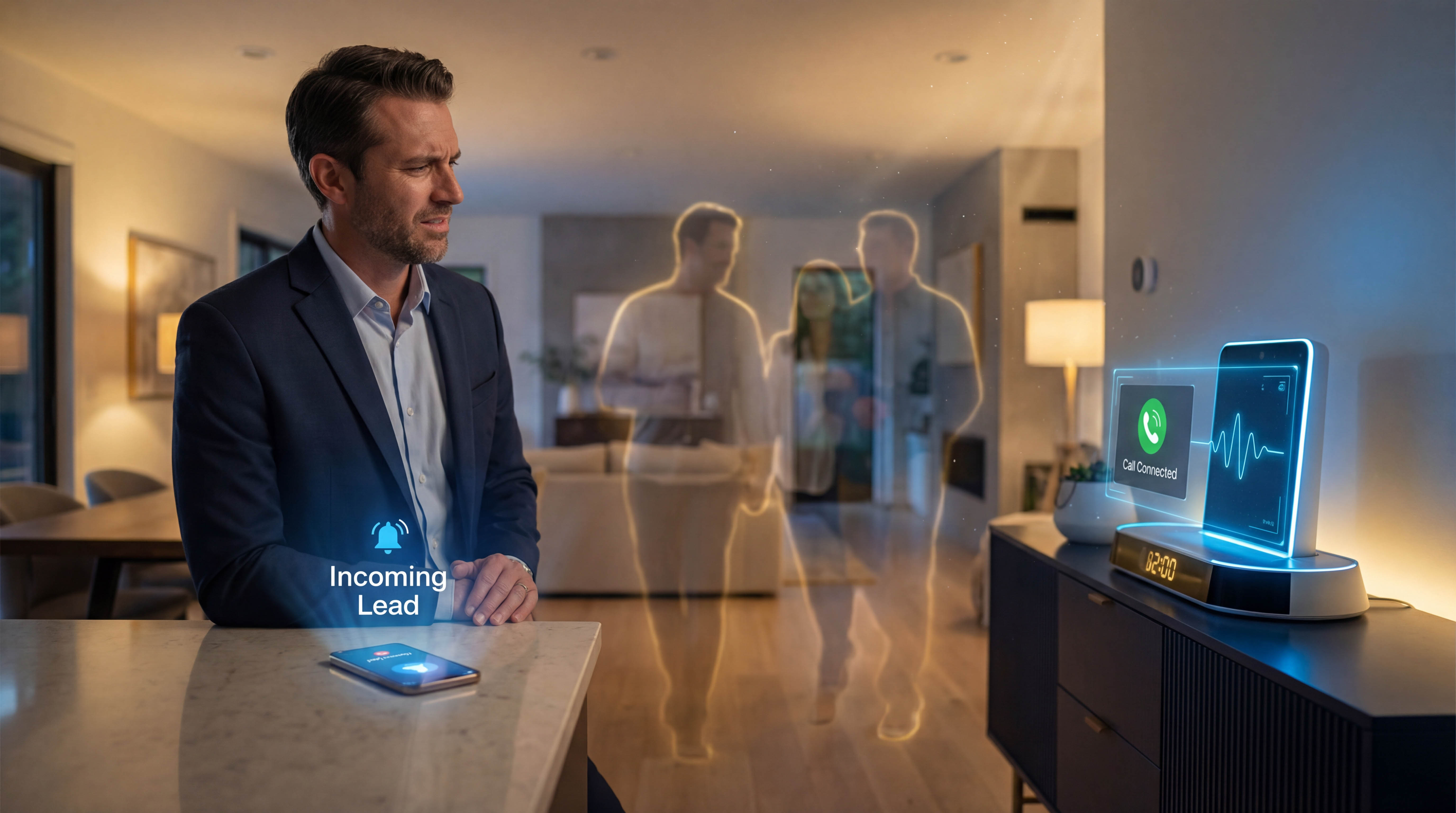
Everyone is afraid of the wrong thing.
The conversation around AI in real estate has been dominated by dread — agents worried about their value, their commission, their relevance in a world where algorithms can pull comps and generate listings in seconds. Podcasts, panels, industry reports all circling the same anxious question: will AI replace us?
That fear is understandable. It's also a distraction.
Because while agents are looking over their shoulder at some hypothetical AI that might steal their job in ten years, a very real and very present problem is bleeding them right now. Not dramatically. Quietly. Lead by lead, call by call, missed opportunity by missed opportunity.
The AI disruption in real estate isn't coming. It's happening. And it has almost nothing to do with the thing you're afraid of.
This isn't a piece about technology. It's a piece about time — and what happens in the gap between when a lead reaches out and when you reach back.
If you work in real estate, mortgage, insurance, home services, legal, or any industry where the phone converts clients, bookmark this. Not because I'm going to tell you something you haven't heard before, but because I'm going to say the thing clearly that everyone else has been dancing around.
Let's begin.
I — The Market Has Always Rewarded Speed. AI Just Made the Gap Catastrophic.
"We are what we repeatedly do. Excellence, then, is not an act, but a habit." — Aristotle
Speed in business isn't a new idea. The fastest gunslinger. The first mover. The early bird. Every era of commerce has rewarded the person who shows up first. What's changed isn't the principle — it's the stakes.
Think about a real estate agent you know. A good one. Someone who has built their business on relationships, hustle, and an ability to actually connect with buyers and sellers in a way that a website never could. Do you think they're losing clients because they're bad at their job?
They're not.
They're losing them because of a window that lasts less than five minutes.
The data is brutal: 78% of buyers choose the first agent who responds to their inquiry — not the most experienced agent, not the agent with the best reviews, not the agent who closed the most transactions last quarter. The fastest one. Leads contacted within five minutes of reaching out are 21 times more likely to convert than leads contacted after thirty minutes.
Twenty-one times.
This isn't a stat about technology. This is a stat about human psychology. When someone reaches out about a home — that moment of curiosity, that moment of need — they are at peak emotional readiness. They want to move. They have questions. They are, at that exact second, a willing participant in a conversation that could change the trajectory of your business.
Then three hours pass. You're showing a home. You're in a meeting. You're doing exactly what a professional is supposed to do. And by the time you call back, that window has closed.
The lead didn't go cold.
The lead went somewhere else.
The gap between when a lead reaches out and when an agent can realistically respond used to be a minor inefficiency. Now, with the rise of AI-powered competitors who respond within seconds, it's become the single most expensive problem in the industry. And most agents don't even know how much it's costing them, because the leads that disappear don't send a breakup message. They just go quiet.
II — The Agents Who Lose the Most Are Often the Best at Their Job
"The curious paradox is that when I accept myself just as I am, then I can change." — Carl Rogers
Here is the part that nobody says out loud, because it sounds almost cruel once you name it.
The agents who miss the most leads are often the agents doing the most work.
They're not scrolling their phones between showings. They're in showings. They're not ignoring their voicemails. They're at the table, negotiating on behalf of a client who trusted them with the largest financial transaction of their life. They're doing exactly what their profession demands — and the market is penalizing them for it.
This is the philosophical injustice at the core of the problem. The most dedicated agents are the ones most likely to miss an incoming lead, because their dedication to the client in front of them leaves nothing left for the lead waiting behind them.
That's not a personal failure. That's a structural one.
And here's what makes it worse: the average agent loses three to five qualified leads per month this way. At an average commission of $9,000 to $15,000 per transaction, that's between $27,000 and $75,000 a year disappearing into the silence of a missed call. Over three years, you're looking at over $150,000 in potential income that didn't go to a better agent. It went to a faster one.
The profession that rewards excellence in the long game is being quietly disrupted by a short game most agents don't even know they're playing.
III — The Real AI Disruption Is Not What You Think
Everyone is watching for the replacement. The AI that writes the listing. The algorithm that generates the offer. The chatbot that schedules the tour.
Those things exist. They're useful. They're not the disruption.
The actual disruption is quieter and more immediate: AI is replacing human unavailability.
Not your judgment. Not your relationships. Not your ability to read a room, negotiate a deal, or hold a client's hand through the most stressful purchase of their life. Those things cannot be replaced, and the agents who understand this will build careers that last decades.
What AI replaces is the gap.
Think of a lead like fresh fruit. The moment someone reaches out, they're at peak ripeness — ready to engage, ready to be guided, ready to choose an agent. Leave them on the counter for three hours and that fruit doesn't stay fresh. By the time you get home from your showing, they've already had a conversation with someone else. By the time you call back, they're no longer evaluating agents. They're planning a first showing with the one who answered.
The AI that wins in real estate doesn't close deals. It keeps deals alive until the human can close them.
This is a distinction most people miss because they're still thinking about AI as a replacement rather than a relay. The relay exists in professional sports, in surgery, in manufacturing. Different people own different parts of the process, each one optimal for what they're doing. The AI's job is to hold the baton — the lead's attention, engagement, and trust — until you're ready to receive it.
That's not a threat to what makes you valuable.
That's what makes your value possible.
IV — This Problem Has No Industry Exemption
Real estate gets the attention because the numbers are dramatic. A $15,000 commission lost to a missed call is a story. But the same structural problem exists in every industry where a phone call converts a client.
The mortgage broker who is on a call with a refinance client when a new purchase lead comes in.
The HVAC company that doesn't answer at 7pm on a Friday when the heat goes out.
The personal injury attorney whose intake line rings out at 9pm when someone was just in an accident.
The insurance agent who calls back the next morning to find that another broker got there at 10:45 the night before.
The dental practice that loses a new patient inquiry every weekend because nobody is monitoring the form submissions until Monday.
These aren't edge cases. They are the standard operating reality of any business that depends on a human conversation to convert a lead — and that human isn't available every hour that a lead might show up.
The industries that solve this problem first won't just grow. They'll own. Because they'll compound the advantage. Every lead converted that a competitor missed becomes a client who refers two more. Every response rate improvement becomes a reputation improvement. Every hour of AI coverage becomes a year of compounded market share.
The businesses that adopt intelligent, autonomous first-response in the next two to three years will look back at this window the way tech companies look back at the early internet. Not as a trend they adopted. As the decision that made everything else possible.
V — Picture Two Versions of the Same Business
Let me paint two pictures. Neither involves a bad agent or a bad business. Just two different choices made at the same fork in the road.
The first business runs the way it always has. Leads come in through the website, through Zillow, through referrals. The owner answers when they can. They follow up when they remember. They're good at what they do. Their close rate with the leads they actually reach is strong. But somewhere between 30% and 50% of their leads are gone before that first conversation even begins. They never know who those people were. They just see a form submitted and a phone that rang once and stopped.
Five years from now, this business is smaller than it looks on paper. Not because of bad market conditions. Not because of competition from technology. Because five years of losing 30% of leads at the first moment of contact compounds into a business that has quietly bled out without ever knowing it was wounded.
The second business made one change. Every lead that comes in — at 2am, on a Sunday, during a showing, during a negotiation — gets an immediate response. Not a form letter. Not a "we'll get back to you." A real, personalized, intelligent conversation that answers questions, qualifies interest, and keeps the lead engaged until the human is ready.
Five years from now, this business is unrecognizable compared to its competitors. Not because it spent more on marketing. Not because it hired better people. Because it stopped losing at the first point of contact, and it let those compounding conversions do what compounding always does.
The difference between these two businesses is not talent.
It's not budget.
It's not market conditions.
It's availability.
VI — The Guide Is Already Built
This is where I'll be direct, because everything I've laid out leads here.
The gap is real. The cost is documented. The structural problem is clear. And the solution already exists — built specifically for the people who need it most.
Josey.ai was built for the agent who is too busy doing their job to answer the phone.
That sounds simple. It's not, because the alternative — hiring an assistant, building a follow-up system, training someone to handle your leads — is anything but. Most solutions to this problem add complexity to a profession that is already complex enough.
Josey removes the complexity. If you can write an email, you can set up Josey. You write out how you'd respond to a new lead — the questions you'd ask, the tone you'd use, the things you'd want them to know — and Josey becomes your always-on first response. Within seconds of a lead reaching out, they hear from you. Not a delay. Not a form. A real conversation, in your voice, that qualifies their interest and keeps them warm.
Then you step in exactly where you were always meant to — at the moment of relationship, of negotiation, of closing.
The three steps are this simple:
Tell Josey what to say. Ten minutes. Write it the way you'd write an email to a new client.
Josey handles every first response, immediately, around the clock. No holidays, no sick days, no in-the-middle-of-a-showing delays. Every lead gets an answer within seconds.
You call back a lead that's already engaged, already qualified, already expecting to hear from you. You close the deal. Josey made the deal possible.
This is not a replacement. It is a relay.
And it isn't just for real estate agents. Any business where a human conversation converts a client — mortgage, insurance, law, home services, medical, finance — faces the same gap. The opportunity is the same. So is the cost of waiting.
VII — The Agents Who Win the Next Decade Understand One Thing
The phone call is not dying.
In a world of automated emails, AI-generated content, and algorithmic recommendations, the moment a real human voice engages with a potential client has become more valuable, not less. The scarcity of genuine human attention is only increasing. What the market rewards increasingly is the business that gets to that moment of human conversation more reliably, more consistently, and faster than its competitors.
The agents who win the next decade are not the ones who ignore AI.
They're not the ones paralyzed by fear of it, either.
They are the ones who use AI to protect the thing that makes them irreplaceable — their time, their expertise, their human presence — by letting it handle the one thing no human can do while they're serving another client.
Being available.
Here is the map, in plain terms:
Your leads are the opportunity. Every one has a clock on it.
The gap is the villain. It kills deals before you ever know they existed.
AI first-response is the relay. It holds the clock, holds the lead, holds the door open.
You are the close. The relationship. The reason they stay and refer.
Your competitors who figure this out first become the standard. The rest become the cautionary tale.
The window is open right now. It won't be open forever. The businesses that move while their competitors are still debating will look back at this moment the way early internet adopters look back at 1995 — not with pride, but with the quiet confidence of someone who simply paid attention when it mattered.
The fastest first responder doesn't always win on talent.
But they almost always get the first conversation.
And in this business, the first conversation is most of the game.
Josey.ai handles your first response so you never lose a lead to a missed call again. Set it up in 10 minutes at josey.ai →

Josey AI
Sharing insights on AI and real estate technology to help agents win in 2026 and beyond.